Accessibility Options






 My Account
 Pre Approved Offer
 Make Payment
 Branch
Locator
Branch
Locator Xpress Services
-

Khushiyon ka seasonDrive Growth with HDB Commercial Vehicle Loan
-

Khushiyon ka Season Drive Growth with HDB Tractor Loan
-

Get an Instant Salaried Personal Loan Now! With Attractive Interest Rates*
-

Pre-Owned Car Now Yours! Fulfill Your Dream Drive with HDBFS Car Loan
-
Hyundai - Let's Make It Big Now Own Your Favorite Car with HDBFS
-

Get Honda Two-Wheeler at Low DP Applicable for Honda Shine 100 & Activa only
-

Celebrate Sangeetha's 52nd Anniversary Sale Win a Gold Coin & Get Assured Vouchers worth Rs.60,000*
-
Instant Personal Loan Get an Instant Personal Loan now for upto Rs. 25 Lakhs!
-

Instant Pre-approved Offers Apply for Pre-approved loans in just 5 mins with Zero documentation!
-

HDB ontheGo App One application to view & manage your loan account & also apply for new loan

-
Khushiyon ka seasonCelebrate the Devine Festive of Janmashtami and Grow Your Business with Commercial Vehicle Loan
-
Celebrate the Divine Festive of Janmashtami and Grow Your Business with Tractor Loan
-
Get an Instant Salaried Personal Loan Now! With Attractive Interest Rates*
-
Pre-Owned Car Now Yours! Fulfill Your Dream Drive with HDBFS Car Loan
-
Hyundai - Let's Make It Big Now Own Your Favorite Car with HDBFS
-
Get Honda Two-Wheeler at Low DP Applicable for Honda Shine 100 & Activa only
-
Celebrate Sangeetha's 52nd Anniversary Sale Win a Gold Coin & Get Assured Vouchers worth Rs.60,000*
-

Cashback offers on Iphone17 Pro Cashback offers upto Rs. 5,100*
-
Instant Personal Loan Get an Instant Personal Loan now for upto Rs. 25 Lakhs!
-
Instant Pre-approved Offers Apply for Pre-approved loans in just 5 mins with Zero documentation!
-
HDB ontheGo App One application to view & manage your loan account & also apply for new loan
- Home
-
About Us

-
Products
- Hot Offers NEW
- Blogs
-
Investors
-
Customer Services
- Careers
-
CSR





 My Account
 Pre Approved Offer


Call Us
+91 44 42984541(Charges Applied)10.00am-6.00pm, Mon-Fri (Excluding Holidays)
Follow Us
How Car Loan Documentation Differs for New vs Used Vehicles
2026-07-20


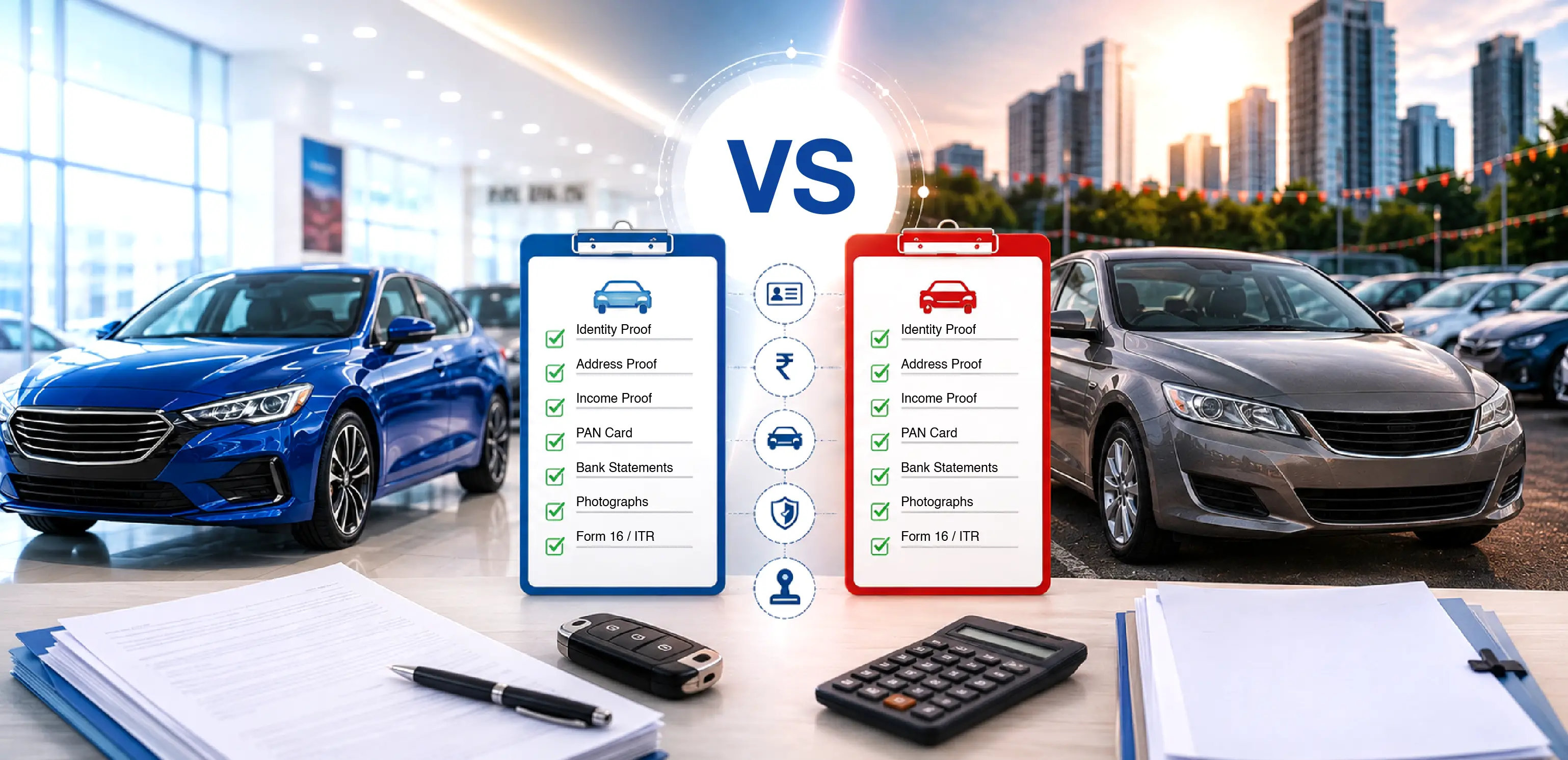
How Car Loan Documentation Differs for New vs Used Vehicles
The process of applying for a car loan in India is a formalised financial procedure. But the paperwork involved varies greatly depending on whether you are buying a new car or a second-hand car.
While both require formal identity and income checks, lenders exercise additional diligence with second-hand car loans for various reasons. Knowing the differences in car loan documentation for new vs second-hand cars can enable borrowers to take the necessary steps.
Understanding the Car Loan Process in India
Before examining documentation differences, it is important to understand how lenders evaluate car loan eligibility. Financial institutions assess:
- Income stability
- Credit score
- Employment profile
- Existing financial obligations
- Vehicle value
- Loan-to-value ratio (LTV)
For new cars, the vehicle’s value is clear and standardised. For used cars, lenders must evaluate depreciation, ownership history, and resale value, which increases documentation requirements.
Car Loan Documentation for New Vehicles
When applying for a new car loan, the documentation process is quite easy because the car is bought directly from an authorised dealer.
1. Standard KYC Documents
For both salaried and self-employed individuals, the following KYC documents are required by the lender:
- PAN Card
- Aadhaar Card / Passport / Voter ID
- Address proof
- Passport-sized photographs
2. Income Proof Requirements
For Salaried Individuals:
- Last 3–6 months’ salary slips
- Bank statements (6 months)
- Form 16
For Self-Employed Individuals:
- ITR (2–3 years)
- Profit & Loss statement
- Balance sheet
- Business bank statements
Income verification is important for determining car loan eligibility.
3. Vehicle-Related Documents (New Car)
Since the vehicle is new, documentation is minimal and dealer-supported:
- Proforma invoice from the dealer
- Booking receipt
- Vehicle quotation
- KYC of dealership (handled internally)
The Registration Certificate (RC) is issued post-disbursement, and the lender’s hypothecation is automatically recorded.
4. Loan Agreement and ECS Mandate
Borrowers must submit:
- Signed loan agreement
- ECS / NACH mandate for EMI deduction
Because the vehicle is new, there is no prior ownership history to verify, which speeds up vehicle loan approval.
Car Loan Documentation for Used Vehicles
Used-car loan documents require additional checks for ownership transfer, valuation, and legal verification.
1. Standard KYC and Income Proof
These are similar to the requirements for new car loans:
- Proof of identity
- Proof of address
- Income documents
- Bank statements
However, stricter income criteria may be applied for used cars as the risk is higher.
2. Previous Ownership Documents
Unlike new vehicle loans, used car loans require detailed ownership verification:
- Original Registration Certificate (RC)
- Form 29 and Form 30 (Transfer of ownership forms)
- No Objection Certificate (if vehicle registered in another state)
- Insurance policy copy
- Pollution Under Control (PUC) certificate
Clarity of ownership is critical for vehicle loan approval.
3. Vehicle Valuation Report
This is a major difference. For used vehicles, lenders require:
- Physical vehicle inspection
- Valuation report by an approved evaluator
- Assessment of depreciation
- Condition verification
The loan-to-value ratio for used vehicles is usually lower (often 50%–80%, depending on age and condition) than the 90% for new cars.
4. Hypothecation Removal (If Applicable)
If the second-hand car had a previous loan:
- Previous lender’s NOC
- Hypothecation termination proof
- Updated RC reflecting loan closure
Without clear title transfer, car loan papers are not complete.
5. Vehicle Age Restrictions
Lenders also evaluate:
- Age of the vehicle
- Remaining usable life
- Maximum loan tenure allowed
For example, a 7-year-old car may receive a shorter loan term than a new vehicle.
Key Differences Between New and Used Car Loan Documentation
| Parameter | New Car Loan | Used Car Loan |
|---|---|---|
| Vehicle Invoice | Dealer proforma invoice | Sale agreement between buyer & seller |
| RC Availability | Issued post-purchase | Existing RC required |
| Valuation Report | Not required | Mandatory |
| Ownership Verification | Not applicable | Mandatory |
| Hypothecation Clearance | Not applicable | Required if prior loan exists |
| LTV Ratio | Higher (up to 90%) | Lower (50–80%) |
| Processing Time | Faster | Slightly longer |
This comparison clearly shows why used car loan documents are more extensive.
Why Used Car Loan Documentation Is More Detailed
Lenders perform stricter risk assessment for used vehicles because:
- Vehicle value is not standardised — depreciation risk
- Potential mechanical problems
- Legal ownership disputes may arise
- Resale liquidity issues
Thus, the used car loan agreement ensures that the car is legally transferable and financially sound as collateral.
Impact on Car Loan Eligibility
New Car Loan Eligibility
Generally offers:
- Higher loan amount
- Longer tenure
- Lower interest rate
- Faster disbursement
Because the asset is new and carries lower risk.
Used Car Loan Eligibility
May include:
- Slightly higher interest rates
- Shorter repayment term
- Lower LTV ratio
- More document verification
Credit score plays a vital role in reducing these differences.
Common Mistakes Borrowers Make
- Assuming documentation is the same for both
- Not checking ownership records for second-hand vehicles
- Not considering the removal of hypothecation
- Underestimating that the loan amount depends on the valuation
- Incomplete proof of income
These errors can significantly delay vehicle loan approval.
How to Prepare for Smooth Car Loan Approval
For New Vehicles:
- Keep updated salary slips or ITR ready
- Confirm dealer invoice accuracy
- Maintain a strong credit score (750+)
For Used Vehicles:
- Verify RC authenticity
- Ensure no pending loans on the vehicle
- Get an independent vehicle inspection
- Check insurance continuity
- Clarify seller identity and documentation
Being proactive reduces loan processing time.
Does Documentation Affect Car Loan Interest Rates?
Indirectly, yes. Though interest rates are not determined by documentation, risk perception is. Because used cars carry depreciation and resale risk, lenders may charge slightly higher rates than for new cars.
The vital factors are still:
- Credit score
- Income stability
- Employer characteristics
- Loan term
Final Thoughts
Car loan documentation differs significantly between new and used vehicles primarily due to asset risk, ownership verification, and valuation requirements.
For a new car, the paperwork is simplified. For a second-hand car, more documents are required to ensure that everything is in order. By understanding these differences, borrowers can:
- Be better prepared with the necessary documents
- Improve their chances of getting a car loan
- Prevent delays in the processing of their loan
- Get their car loan approved faster
Before applying for a car loan, it is important to ensure that all the necessary documents are in order.