Accessibility Options






 My Account
 Pre Approved Offer
 Make Payment
 Branch
Locator
Branch
Locator Xpress Services
-

Khushiyon ka seasonDrive Growth with HDB Commercial Vehicle Loan
-

Khushiyon ka Season Drive Growth with HDB Tractor Loan
-

Get an Instant Salaried Personal Loan Now! With Attractive Interest Rates*
-

Pre-Owned Car Now Yours! Fulfill Your Dream Drive with HDBFS Car Loan
-
Hyundai - Let's Make It Big Now Own Your Favorite Car with HDBFS
-

Get Honda Two-Wheeler at Low DP Applicable for Honda Shine 100 & Activa only
-

Celebrate Sangeetha's 52nd Anniversary Sale Win a Gold Coin & Get Assured Vouchers worth Rs.60,000*
-
Instant Personal Loan Get an Instant Personal Loan now for upto Rs. 25 Lakhs!
-

Instant Pre-approved Offers Apply for Pre-approved loans in just 5 mins with Zero documentation!
-

HDB ontheGo App One application to view & manage your loan account & also apply for new loan

-
Khushiyon ka seasonCelebrate the Devine Festive of Janmashtami and Grow Your Business with Commercial Vehicle Loan
-
Celebrate the Divine Festive of Janmashtami and Grow Your Business with Tractor Loan
-
Get an Instant Salaried Personal Loan Now! With Attractive Interest Rates*
-
Pre-Owned Car Now Yours! Fulfill Your Dream Drive with HDBFS Car Loan
-
Hyundai - Let's Make It Big Now Own Your Favorite Car with HDBFS
-
Get Honda Two-Wheeler at Low DP Applicable for Honda Shine 100 & Activa only
-
Celebrate Sangeetha's 52nd Anniversary Sale Win a Gold Coin & Get Assured Vouchers worth Rs.60,000*
-

Cashback offers on Iphone17 Pro Cashback offers upto Rs. 5,100*
-
Instant Personal Loan Get an Instant Personal Loan now for upto Rs. 25 Lakhs!
-
Instant Pre-approved Offers Apply for Pre-approved loans in just 5 mins with Zero documentation!
-
HDB ontheGo App One application to view & manage your loan account & also apply for new loan
- Home
-
About Us

-
Products
- Hot Offers NEW
- Blogs
-
Investors
-
Customer Services
- Careers
-
CSR





 My Account
 Pre Approved Offer


Call Us
+91 44 42984541(Charges Applied)10.00am-6.00pm, Mon-Fri (Excluding Holidays)
Follow Us
How Financial Cybersecurity Protects More Than Just Your Money (2026 Edition)
2026-04-06


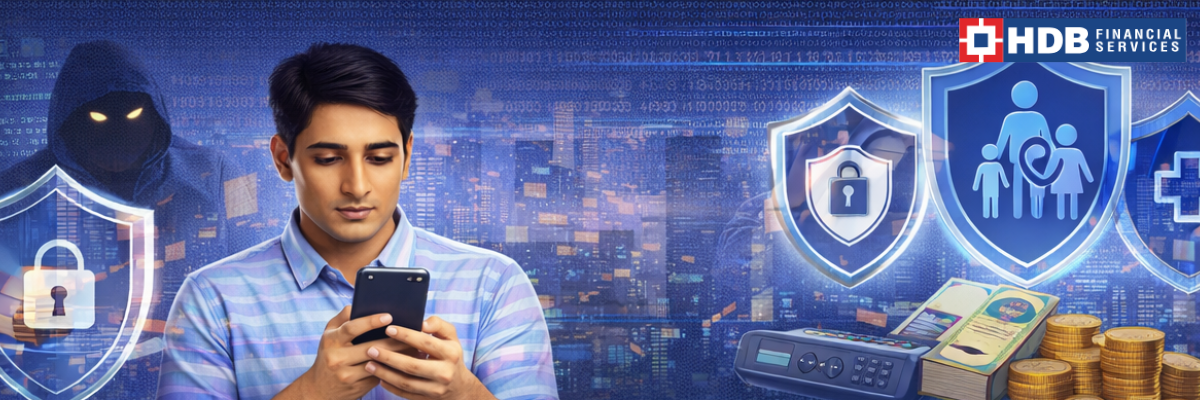
How Financial Cybersecurity Protects More Than Just Your Money
When most people hear the word “cybersecurity,” they think of hackers breaking into bank accounts or stealing passwords. But financial cybersecurity is no longer a silent shield working behind the scenes—it has become a living ecosystem that protects your identity, autonomy, trust, and long-term financial wellbeing. In today’s rapidly digitising world, banks are not just vaults for money; they are vaults for your life data. And what happens inside those digital vaults determines far more than your account balance.
Below, we dive into how modern security systems in finance safeguard your larger world: your reputation, your choices, your future.
1. The New Battlefield: Why Money Isn’t the Only Target Anymore
For decades, criminals targeted banks for cash. Today, they target people for data. A stolen identity can be used to take loans in your name, claim government benefits, damage your credit score, or even create entire fraudulent digital personas.
This is why financial cybersecurity has evolved from a defence mechanism into a multi-layered strategy that protects every touchpoint of your financial identity. Banks now focus on behavioural analysis, device fingerprinting, and AI-driven fraud detection—because what’s at stake is no longer only your savings, but your digital self.
2. How Cybersecurity Preserves Trust in Digital Banking
Imagine logging into your banking app and feeling even a sliver of doubt—Is this safe? That hesitation alone can collapse the entire digital banking experience. Trust is the currency that makes online finance possible.
Advanced encryption, secure APIs, multi-factor authentication, and biometric verification aren’t just technical upgrades; they are trust-building tools. They ensure that your interactions with your bank remain predictable, private, and protected—even as threats evolve.
And this is where financial cybersecurity plays its deeper role: maintaining the invisible trust contract between institutions and customers. If trust breaks, people hesitate. If people hesitate, digital banking slows down. Cybersecurity keeps that cycle moving.
3. Your Digital Reputation: A New Asset Worth Protecting
Few people realise that reputational damage can be more costly than monetary loss.
A tampered credit score can affect:
- Your ability to rent a home
- Your job prospects
- Your insurance premiums
- The interest rates you receive
Cybercriminals know this. They understand that altering a person’s financial profile can trigger real-world consequences that last years.
This is why banks are investing heavily in monitoring unusual patterns—like multiple credit checks, suspicious loan applications, or sudden login attempts from distant geolocations. These aren’t just fraud-prevention strategies; they’re reputation-protection strategies.
Through proactive systems, financial cybersecurity detects and blocks these attacks before they spill over into your real life.
4. The Emotional Burden of Cybercrime—and How Cybersecurity Reduces It
Money can be earned back. But the emotional trauma of digital theft—fear, embarrassment, anxiety—lingers longer.
Victims often describe:
- Panic over compromised private information
- Guilt for “falling for a trick”
- Long battles to restore accounts and documentation
- A chilling sense of being watched
By preventing breaches before they happen, banks reduce not just financial risk but psychological harm. Behind every security alert, firewall, or biometric scan is a quiet promise: You don’t have to carry this burden.
In this way, financial cybersecurity protects human wellbeing—not just digital assets.
5. Cybersecurity as a Driver of Innovation, Not a Roadblock
Many people think cybersecurity slows things down. But in reality, the strongest financial innovations exist because of strong cybersecurity frameworks.
Consider the digital tools we use today:
- UPI and instant payments
- Paperless KYC
- Investment apps
- Buy-now-pay-later services
- Mobile wallets
-
Robo-advisors
All of them function only because security systems ensure that every transaction, verification, and data transfer is tightly safeguarded.
When customers feel safe, they explore more possibilities. They try new financial products. They invest. They automate. They grow.
Cybersecurity isn’t a barrier—it’s the soil that lets innovation grow strong roots.
6. How Cybersecurity Protects Families and Long-Term Stability
A cyberattack doesn’t only harm an individual. It affects entire households. For example:
- A parent’s compromised account can delay school payments.
- A grandparent scammed through phishing can lose retirement savings.
- A young adult’s stolen identity can damage their credit before life has even begun.
Modern systems now include family-wide protections such as fraud warnings, account monitoring alerts, and spending pattern analyses.
This ensures that the ripple effects of cybercrime don’t disrupt long-term financial health. Financial cybersecurity becomes a tool for safeguarding generational stability—not just day-to-day transactions.
7. The Rise of “Cyber Literacy” and Why It Matters
Banks can build the best systems in the world, but one careless click can still open the door to an attacker. That’s why banks are now investing in customer education as part of their cybersecurity strategy.
Today, users are learning to:
- Recognise phishing links
- Avoid sharing OTPs
- Verify suspicious emails
- Identify fake apps
- Use strong passwords
- Report fraud early
This shift from passive users to informed digital citizens is one of the most powerful outcomes of strong cybersecurity efforts. The safest financial systems are those where customers and banks work together—not separately.
8. The Future: Invisible Security That Works Silently for You
The next era of cybersecurity will be mostly invisible. You won’t see it. You won't interact with it. But it will surround your financial life like a protective atmosphere.
We’re moving toward:
- Passwordless banking
- Continuous authentication (your behaviour becomes your password)
- AI-driven fraud prediction
- Real-time risk scoring
- Fully encrypted digital identities
- Secure digital public infrastructure
In this world, cyber defences will adapt faster than threats, giving users a seamless and safe experience that doesn’t require active effort.
This is the ultimate promise of financial cybersecurity: protection that works quietly, intuitively, and automatically—giving you the freedom to focus on living your life, not defending it.
Final Thoughts
Your bank account is only one of the many things worth protecting in the digital age. Your name, identity, reputation, decisions, dignity, peace of mind, and financial future are all intertwined in the vast digital web of modern life.
And that is why cybersecurity matters. Not because it stops hackers from stealing money—but because it defends the story of you: your choices, your records, your opportunities, your dreams.
Financial cybersecurity is not a technical upgrade. It is a human promise. A promise that the digital world can be a place where trust thrives, growth continues, and your life remains securely your own.